

In today’s information landscape, Wikipedia is more than just another website—it’s the backbone of how people and machines discover information about your institution. With AI assistants, voice search, and chatbots reshaping how prospective students research colleges, your Wikipedia page has become more critical than ever.
Yet many higher ed institutions treat it as an afterthought, if they think about it at all.
This creates a significant vulnerability. When someone asks Alexa about your university, queries ChatGPT for college recommendations, or simply Googles your institution’s name, they’re likely encountering information that traces back to Wikipedia. And if that page is outdated, incomplete, or simply doesn’t exist, you’re invisible in the conversations that matter most.
Fortunately, there’s a right way to manage your Wikipedia presence—one that respects the platform’s rules while ensuring your institution is accurately represented. This guide will walk you through why Wikipedia matters in the AI age, the risks of neglecting it, and the specific steps to improve your page while staying firmly within Wikipedia’s guidelines.
Why Wikipedia Matters More Than Ever for AI Visbility
Wikipedia’s influence extends far beyond its 7 million+ English articles and billions of monthly views; in the age of AI, it functions as the database that defines whether or not your institution “exists” as a recognized entity on the internet.
When prospective students search for your institution, Wikipedia typically ranks at or near the top of results. Perhaps more importantly, Google’s Knowledge Panels—those information boxes that appear on the right side of search results—almost always draw their descriptions and key facts directly from Wikipedia. This means Wikipedia’s description of your college is often what people see before they visit your website, even if they never visit your school’s Wikipedia article.

Wikipedia has essentially become a database of what is ‘real.’ It makes your institution visible to the internet’s exchange of ideas. If you’re not there, if you’re not an entity in that database, then you don’t really exist.


Modern tech tools have amplified Wikipedia’s importance dramatically. Voice assistants like Alexa, Siri, and Google Assistant rely heavily on Wikipedia for information about organizations and brands, with one study finding that they used Wikipedia for 99% of their answers. When someone asks their smart speaker about your university, they’re hearing Wikipedia’s content read aloud.
Generative AI tools have deepened this dependence. ChatGPT and similar systems often rely on Wikipedia to generate their content; in fact, according to AI analytics platform Profound, Wikipedia accounted for 7.8% of all citations on ChatGPT out of a dataset of 680 million citations. That’s more than four times higher than Reddit, the next-highest cited source.
ChatGPT Citation Volume |
|
| Source | Percentage of Total Citations |
| Wikipedia | 7.8% |
| 1.8% | |
| Forbes | 1.1% |
| G2 | 1.1% |
| TechRadar | 0.9% |
| NerdWallet | 0.8% |
| BusinessInsider | 0.8% |
| NYPost | 0.7% |
| Toxigon | 0.7% |
| Reuters | 0.6% |
(source)
When users ask these tools about colleges, the responses often draw heavily from Wikipedia content. If your competitors have well-developed Wikipedia pages and you don’t, AI systems will view them as more authoritative and may omit your institution from answers entirely.
The Risks of Outdated or Incomplete Pages
A poorly maintained Wikipedia page is more than just a missed opportunity—it can even be an active liability.
Outdated information spreads rapidly; if your Wikipedia page still lists a former president, old enrollment figures, or programs that no longer exist, that misinformation propagates across the web. AI tools repeat it, journalists cite it, and prospective students form an inaccurate opinion of your school.
On the other hand, a high quality page features up-to-date and accurate information pulled from reputable, relevant sources.
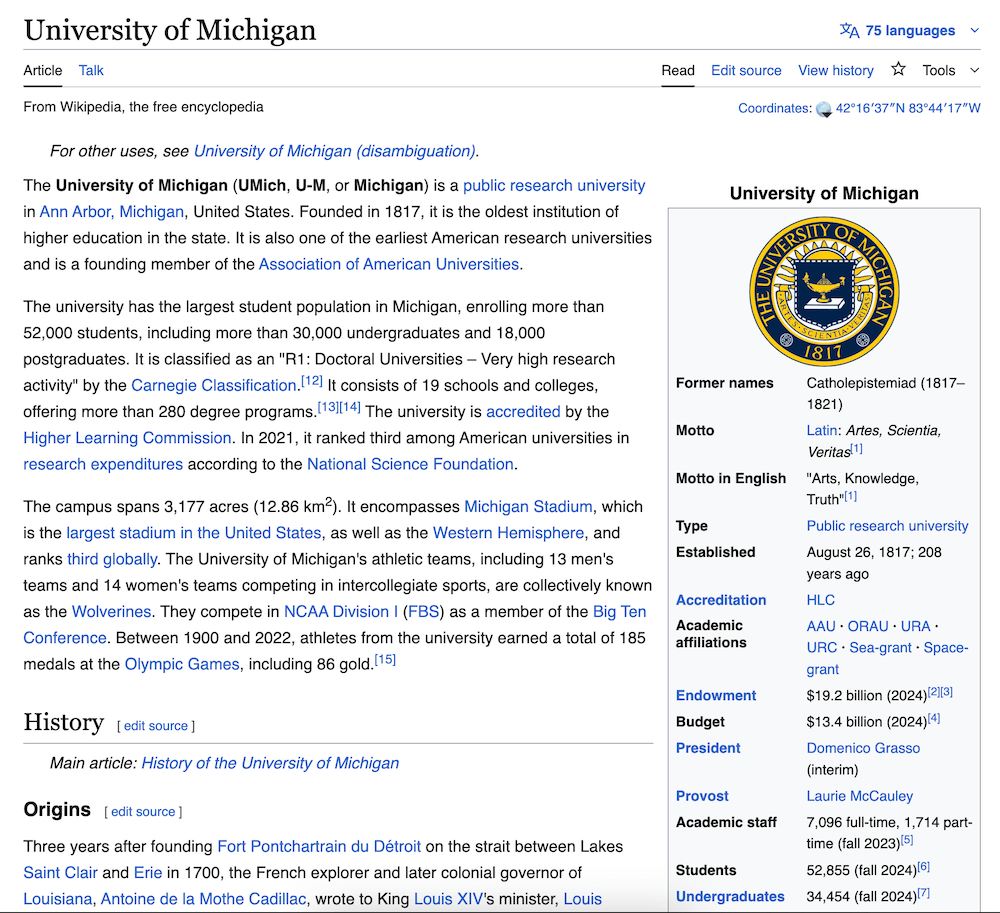
The stakes are especially high for universities precisely because Wikipedia is one of the primary research sources for prospective students. One way or another—via Knowledge Panels, AI chat, or visiting Wikipedia directly—people are getting information about your school from Wikipedia; if that information is wrong or incomplete, you’re actively misinforming hundreds or thousands of people who are making significant decisions about their education.
Wikipedia is one of the primary research sources for prospective students. They’re going to go in there looking up information about your campus, your history, your facilities, academic rankings.
The AI angle is critical. Because Wikipedia content feeds into AI systems, errors get amplified. ChatGPT and other tools will mischaracterize your institution or even leave you out of recommendations to students asking for college suggestions.
Understanding Wikipedia’s Culture and Content Standards
Well-maintained Wikipedia articles are essential for colleges and universities. But before attempting to improve your institution’s Wikipedia presence, you need to understand something fundamental: you don’t own your Wikipedia page. The community does.
This has significant implications for the type of content your school’s article can include, the manner in which it is presented, and how you can go about requesting (yes, requesting) that it be added to your page.
Three Pillars of Wikipedia’s Content Policy
Wikipedia operates under policies that apply equally to everyone, from university presidents to PR professionals. The three pillars of Wikipedia’s content policy are Neutral Point of View, Verifiability, and No Original Research.
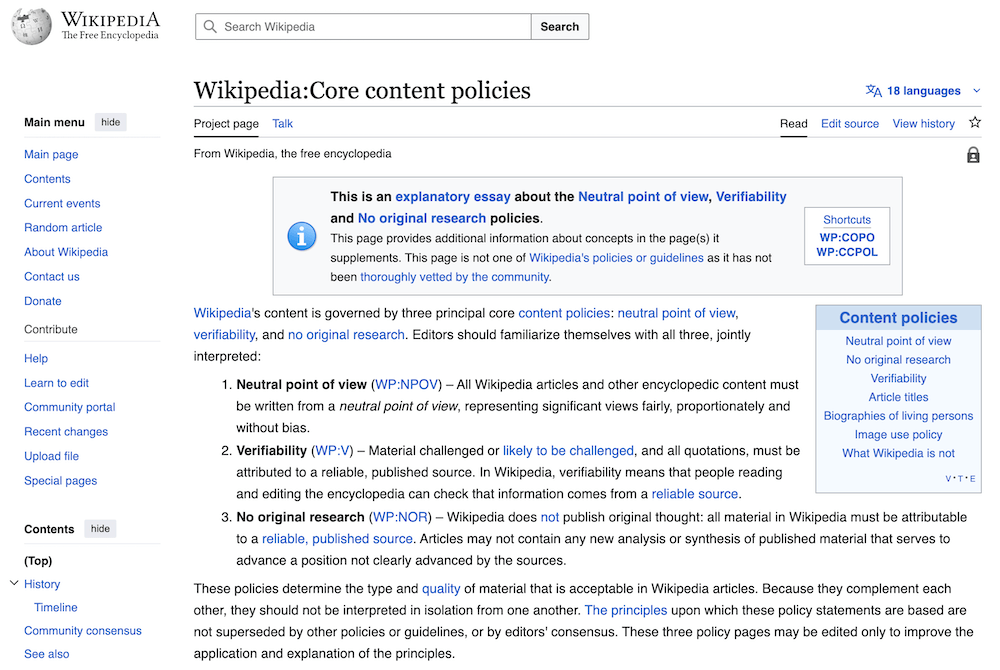
In short, these three interrelated concepts mean that everything on your page must be written in a neutral, encyclopedic tone and backed by reliable, published sources.
- Neutral Point of View: Unlike institutional marketing materials, Wikipedia articles must avoid promotional language and instead present information in a neutral manner. Articles are intended to summarize and contextualize information about institutions, not serve as admissions brochures. Rather than relying on phrases like “world-class institution,” “leading university,” or other marketing-speak, let the facts—ranking positions, research funding, notable alumni achievements—speak for themselves.
Terms like ‘best,’ ‘premier,’ ‘world-renowned,’ and so forth are going to be flagged by other editors because they imply some sort of abstract and positive sentiment about the school that’s not backed up by data. Everything has to be sourced.
- Verifiability: Every significant claim needs attribution to a reputable source, so that readers can validate information for themselves. A common mistake: citing only the college’s own materials. While some basic facts can come from official sources, Wikipedia editors strongly favor third-party coverage from reputable sources in order to establish notability and avoid conflicts of interest.
- No Original Research: Wikipedia prohibits articles from including original thought, research, or analysis; all content must be sourced directly from reliable published sources. This principle is perhaps less relevant for higher ed articles than the previous two policies, but it applies nonetheless. You must limit yourself to what is explicitly included in reliable sources, and cannot infer or synthesize claims about your school.
Conflict of Interest: The Critical Issue
If you’re editing an article about your own institution (or if you’re a marketing agency acting on behalf of one), then you have a conflict of interest (COI), by Wikipedia’s definition. This isn’t a moral judgment, but rather a factual recognition that you are inherently invested in how the school is portrayed.
If you’re affiliated with an institution—or really, any type of brand—then you have a financial motivation for that entity to do well. That’s a conflict of interest. And conflict of interests potentially bring bias to the edits that you’re making.
Wikipedia’s rules strongly discourage directly editing articles where you have a COI; doing so can get you blocked from making further edits, and can create an unflattering look for your brand (and, in some cases, could even lead to the removal of your article).
So does this mean that you’re barred from making contributions to your institution’s Wikipedia page? No—but you must take care to follow the proper procedure: disclose your affiliation and propose changes for others to review.
Conflict of Interest Wikipedia Editing, Simplified
There are three basic components to editing Wikipedia when you have a COI.
- Creating an account as an individual, rather than an institution or group (e.g., “StateU Alex”, rather than “StateU PR Dept”)
- Openly stating your COI on your user profile and on any edit requests you make
- Suggesting edits on an article’s “Talk” page (rather than making edits directly), or submitting a brand new page for review by impartial editors
It’s highly recommended that you review Wikipedia’s COI guidance before you even create an account; not only does it spell out best practices, it also includes templates and other resources to help ensure you execute properly.
Wikipedia for Higher Ed: Content Strategy and Expectations
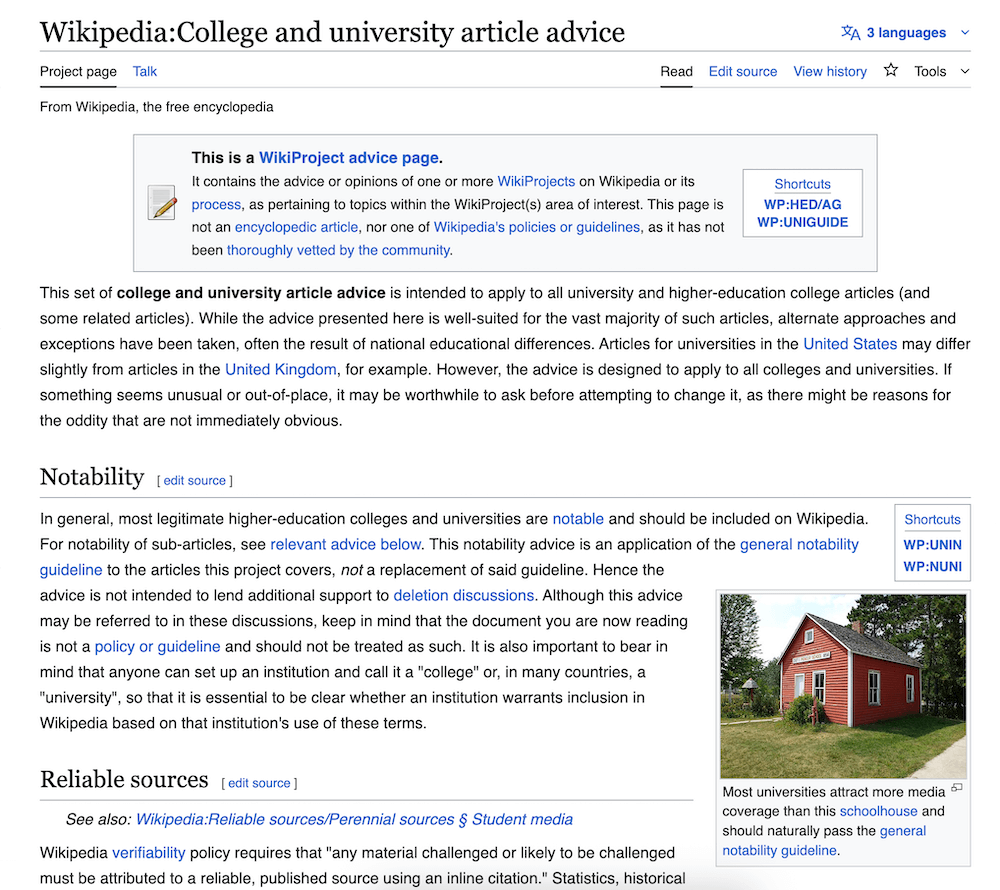
While the same core content standards apply across Wikipedia, specific types of articles (like articles about institutions of higher education) have their own standards that inform content, formatting, and more.
Over the years, Wikipedians have developed specific conventions for college and university pages; in conjunction with Wikipedia’s general content standards, these higher ed guidelines should be your North Star when planning edit requests.
Key Content Areas for Higher Ed Pages
Most university articles follow a standard structure, with sections such as:
- History: Founding and major milestones
- Campus/Facilities: Physical infrastructure and locations
- Organization and administration: Governance structure
- Academics/Academic profile: Faculties, colleges, notable programs, research strengths
- Admissions and costs: Enrollment data and financial information
- Student life: Athletics, clubs, traditions, residential life
- Student body: Demographics and statistics
This structure helps readers and editors navigate content efficiently. If a particular aspect is extensive—like athletics or a famous research lab—Wikipedia encourages creating sub-articles or separate list articles to keep the main page focused. Many universities have spin-off articles like “University of X athletics” or “List of University of X alumni.”
Avoiding Academic Boosterism
It’s natural to feel proud of your institution’s reputation, but Wikipedia explicitly warns against academic boosterism. As such, you must avoid florid praise, vague superlatives, and so-called “peacock terms.”
Wikipedia editors humorously note that reading many college articles makes it sound like every school is “above average”—the Lake Wobegon effect. To combat this, describe institutions in neutral language and let readers decide for themselves.
Avoiding promotional language can take some getting used to, but it can actually make the content stronger. Rather than saying ‘We have a thriving campus scene,’ or something to that effect, name the number of clubs at the school. Mention that you’re represented in X number of collegiate sports leagues, and give the source. Then, you’re just presenting the facts. And facts are compelling.
Instead of “prestigious engineering programs,” write “the engineering college was ranked #5 nationally by [Source] in 2024.” Rather than “thriving campus life,” mention “over 200 student-run organizations, including 20 fraternities and sororities.” Granular, verifiable details beat generalized praise every time.
Sourcing Requirements
Quality sources make or break edit requests. Wikipedia favors:
- Major news organizations (The New York Times, Chronicle of Higher Education, regional newspapers)
- Academic and scholarly sources
- Government databases (NCES, Department of Education statistics)
- Reputable ranking organizations (U.S. News, Times Higher Education)
- Industry publications relevant to your programs’ domains
Your own press releases and institutional materials can support basic facts like enrollment numbers or degree offerings, but for claims about quality, reputation, or achievements, you need independent third-party coverage. If major media outlets or academic publications haven’t written about something, Wikipedia probably won’t include it.
Notability for New Articles
In addition to all of the guidelines above, if you’re creating a new page for an institution then there is another criteria you must meet: notability, or Wikipedia’s requirement that the subject has “significant coverage in multiple reliable secondary sources that are independent of the subject.” Most accredited colleges easily meet this threshold, but it has implications for the nature of the sources you can rely on in your draft (as well as for the process, which we’ll address below).
If you’re an accredited institution, the accreditation alone is basically enough to warrant a Wikipedia article—but you still need to collect a number of third party sources for you to build out that first article.
How to Improve a Wikipedia Page the Right Way
Improving a Wikipedia page requires patience, research, and respect for community norms. Here’s the methodical approach that works.
Step 1: Audit the Existing Article
Read your institution’s current Wikipedia page carefully. What information is missing or outdated? Which sections are underdeveloped? Note any factual errors, insufficiently sourced content, or potentially biased language.
Compare your page to articles about peer institutions—particularly those similar in size, type, or region. Are they more comprehensive? Do they have sections that yours lacks? You could easily streamline the process by prompting AI tools to review other institutions’ articles, compare them with your own, and highlight areas for improvement.
This comparison reveals gaps and provides models for improvement. Remember to refer to Wikipedia’s college and university article standards as well for guidance on expectations and structure.
Check the article’s Talk page and edit history. This shows what issues editors have discussed and what changes have been controversial. Understanding this context helps you avoid repeating past mistakes.
Step 2: Collect Reliable, Third-Party Sources
The bulk of your preparation work isn’t writing new copy, it’s finding the sources that justify your additions. Every significant change to Wikipedia requires a citation to a reliable source. Focus on recent sources (within the past few years) when possible, especially for statistics and current information.
Of course, some information will inherently rely on older sources (for example, the construction of a new facility, or the appointment of a new provost); in such cases, use the best contemporaneous sources available.
The bulk of the work is not just the copy changes, it’s actually finding the sources that will allow you to make those additions because every addition will need some sort of source justifying that factual information.
Create a document organizing your sources by topic or section. This makes it easier to craft proposals and respond to editor questions later. Once again, while your own press releases or institutional materials can support basic facts, claims about quality, reputation, or achievements require independent third-party coverage.
Step 3: Align Your Team and Prepare Your Edits
Writing for Wikipedia is not the same as writing marketing copy on behalf of your institution. As such, you’ll likely need to help stakeholders who review your proposed edits to understand the nuances of Wikipedia’s content standards.
Share Wikipedia’s policy guidelines with any compliance and editorial team members to help them get up to speed on the specifics. Then, prepare a draft of your edits according to Wikipedia’s standards—well sourced, verifiable, and written from a neutral perspective.
When ready, share this draft with your team, and make sure they’re aware that it’s only a proposal—final decisions regarding content changes are made by Wikipedia’s volunteer editors, not by your team.
Step 4: Create Your Account and Disclose COI
Create a Wikipedia account if you don’t already have one. On your user page, clearly state your affiliation: “I work in communications at X University” or similar disclosure.

In addition to stating your affiliation, it is also recommended to use COI templates to visibly indicate your affiliation. It’s good practice to place relevant templates both on your user page and on the Talk page of any article to which you submit an edit request. This transparency is required and builds trust with editors.
Step 5: Post Requests to Talk Page
When you’re ready to submit your request, navigate to the Talk page for your institution’s article (top left of the screen). This is where you’ll propose changes.
Start a new section with a clear heading like “Proposed updates to enrollment data” or “Suggestion to add information about new research center.”
The right process if you want to update your page is to create a request for authorized Wikipedia editors to make the edits on your behalf.
Use the {{edit COI}} template to flag your request for editors, then provide the exact text you’re proposing (along with the sources supporting it). If you propose revisions to existing content, it’s recommended that you use the text diff template to show the exact changes you’re requesting; this makes it easier for editors to review the changes, potentially resulting in faster implementation.
Submitting an appropriate request
Here’s an example of a simple, well-formatted request:
“I’d like to propose adding the following text to the Faculty section:
‘In 2023, Professor Jane Smith was awarded the Nobel Prize in Chemistry for her work on sustainable catalysis.[1] Smith joined the university’s faculty in 2015 and directs the Center for Green Chemistry.[2]’
Sources: [1] [Nobel Prize announcement link] [2] [University faculty directory or news article]
I work in university communications and am making this request in accordance with COI guidelines. Please let me know if there’s anything I can clarify. Thank you for considering this addition.”
Using text diffs is especially important if you are proposing extensive changes—for example, if your institution’s article is minimal or out-of-date. Remember, Wikipedia editors volunteer their time; show that you respect it by reducing the effort required to review your proposals.
If you are submitting edit requests for multiple sections, consider breaking your request into smaller, more manageable pieces. You may also wish to use the extended content template to make it easier for editors to review one proposed section at a time.
Making it easy for editors is absolutely recommended. These editors are doing volunteer work, and they’re probably editing dozens of other articles a month.
Step 6: Be Patient and Communicative
After posting your request, wait. Don’t immediately post again or attempt to edit the article yourself if there’s no activity within a few days. Indeed, the approval process typically can take two to three months, especially for more substantial edits, though it can be faster if an editor prioritizes your article.
You can check your position in the COI edit request queue at any time; you will likely be at the end of a very long list at first, but diligent editors work through the queue steadily and your place in line will rise.

Editors may engage with you at any time, potentially suggesting changes to your content and/or request format before they make an implementation decision. Maintaining open lines of communication with the specific Wikipedia editors reviewing your article is critical—once you establish a relationship with an editor, responses often become faster.
If months have passed with no response, you can post a polite follow-up or start a discussion at WikiProject Higher Education. If editors suggest changes to your proposed text, work with them collaboratively. They’re trying to help ensure additions meet Wikipedia’s standards.
If your request is declined, ask for feedback. Understanding why helps you craft better proposals in the future. Common reasons include insufficient sourcing, promotional tone, or information that’s not notable enough for Wikipedia’s standards.
Step 7: Monitor and Maintain Long-Term
Wikipedia pages aren’t “set it and forget it.” Information changes, vandals make edits, and well-meaning editors sometimes remove accurate content or add errors.
Add the article to your watchlist so you receive notifications of changes. Check it periodically—perhaps quarterly—to ensure accuracy. If you notice issues, follow the same COI process: disclose and request rather than directly editing.
Having someone consistently monitor your Wikipedia profile is essential, especially since ranking information and academic details influence hundreds of thousands of prospective students researching universities each year.
Creating a New Article (If Needed)
If your institution lacks a Wikipedia article, you’ll need to create one from scratch. This involves drafting a complete article that demonstrates notability and follows all Wikipedia guidelines.
- Study similar institutions’ articles as well as Wikipedia’s higher ed article guidance to get the right structure and tone.
- Find comprehensive sources—expect to cite at least 10-15 independent reliable sources.
- Submit through Articles for Creation, then wait for review. Be prepared for rejection on first submission; review the feedback carefully and revise accordingly.
This process often takes several months. If you lack experience with Wikipedia editing, consider consulting with someone who has successfully created institutional articles before attempting this yourself.
Wikidata: Your AI-Ready Institutional Record
While Wikipedia gets most of the attention, Wikidata deserves equal focus. Wikidata is a structured database that stores factual information about entities—including universities—in a machine-readable format.
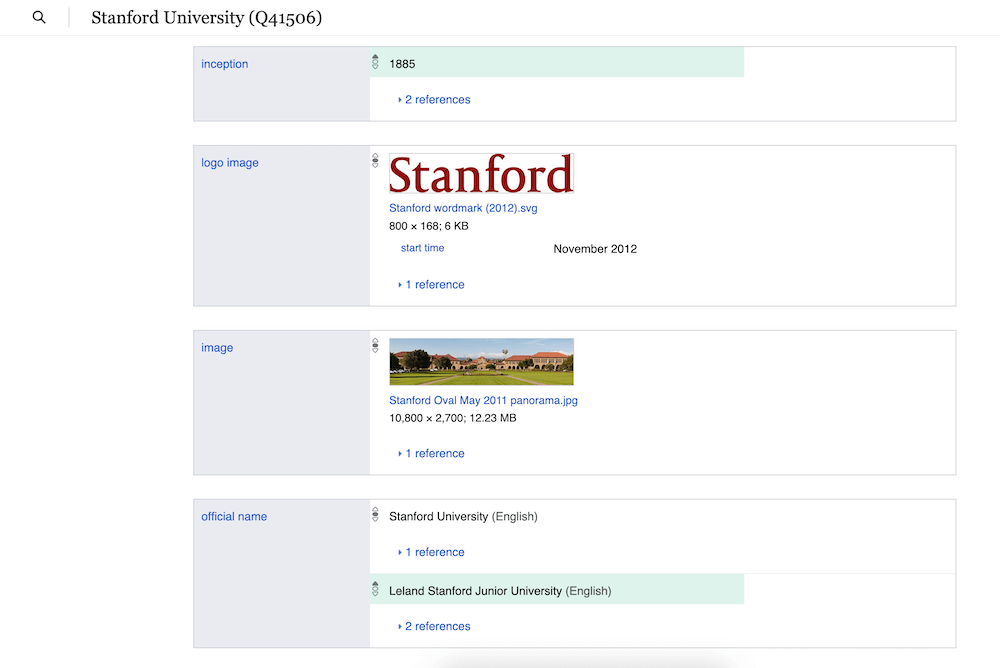
Think of Wikidata as Wikipedia’s data backbone. It stores facts like your institution’s founding date, location, enrollment numbers, official website, and leadership in structured fields rather than prose. This structured data feeds directly into Google’s Knowledge Graph, powers AI assistants, and appears in various automated systems.
As a structured database that feeds into information systems across the internet, Wikidata is key to ensuring accurate, up-to-date details about your institution. It’s essential, and it’s easy to update yourself. Ignoring it is a huge mistake.
Wikidata matters because it’s easier to update than Wikipedia and faces lower barriers for factual corrections. You can update enrollment figures, leadership changes, or contact information on Wikidata with less scrutiny than similar changes on Wikipedia require—though you should still disclose any conflict of interest.
To audit your Wikidata entry, search for your institution on wikidata.org. Check that all fields are accurate and complete. Common fields to verify include:
- Official name and alternative names
- Inception/founding date
- Location coordinates
- Official website URL
- Student population figures
- Number of employees/faculty
- Current president or chancellor
- Accreditation information
Making corrections on Wikidata is straightforward: click “edit” next to any field and provide the updated information with a reference. Because Wikidata feeds into so many automated systems, keeping it current ensures AI tools and knowledge panels display accurate information about your institution.
Building Visibility Through Internal Links
Beyond your main article, Wikipedia offers opportunities to increase your institution’s visibility through strategic linking. Think of this as strengthening your entity by associating it with other well-known entities across Wikipedia.
Wikipedia’s value to your institution increases when references to your school appear in relevant contexts throughout the encyclopedia. This happens through:
- Thematic lists: Lists like “Liberal arts colleges in the United States” or “Universities in California”
- Category pages: Categories organize articles by topic, region, and type
- Alumni and faculty articles: When notable individuals have Wikipedia pages, those articles should mention and link to your institution
- Navigation templates: Footer templates that group related institutions
- Research and topic articles: Pages about research areas or academic topics where your institution has made contributions
Identifying Link Opportunities
Start with your most notable alumni and faculty members who have Wikipedia pages. Check whether these articles mention your institution in their background or education sections. If they don’t—and it’s relevant to include—you can propose adding this information following the same edit request process.
The real strength of Wikipedia is in proving the legitimacy of your institution as a digital ‘entity.’ That strength gets even stronger when you bolster connections with other entities on Wikipedia… Are there notable alumni who’ve been vocal about their time at your school? See if there’s a reasonable opportunity to request a mention be added to their page.
Similarly, if your institution contributed to groundbreaking research in a particular field, check whether the Wikipedia article about that research topic or discovery mentions your university. If your professors were involved in notable projects or studies covered on Wikipedia, these represent valuable linking opportunities.
Making Link Requests Respectfully
You can request these links by posting on the Talk pages of relevant articles or lists. Be strategic and relevant—don’t spam links everywhere. Focus on genuinely appropriate contexts where your institution belongs and where the mention adds value for readers.
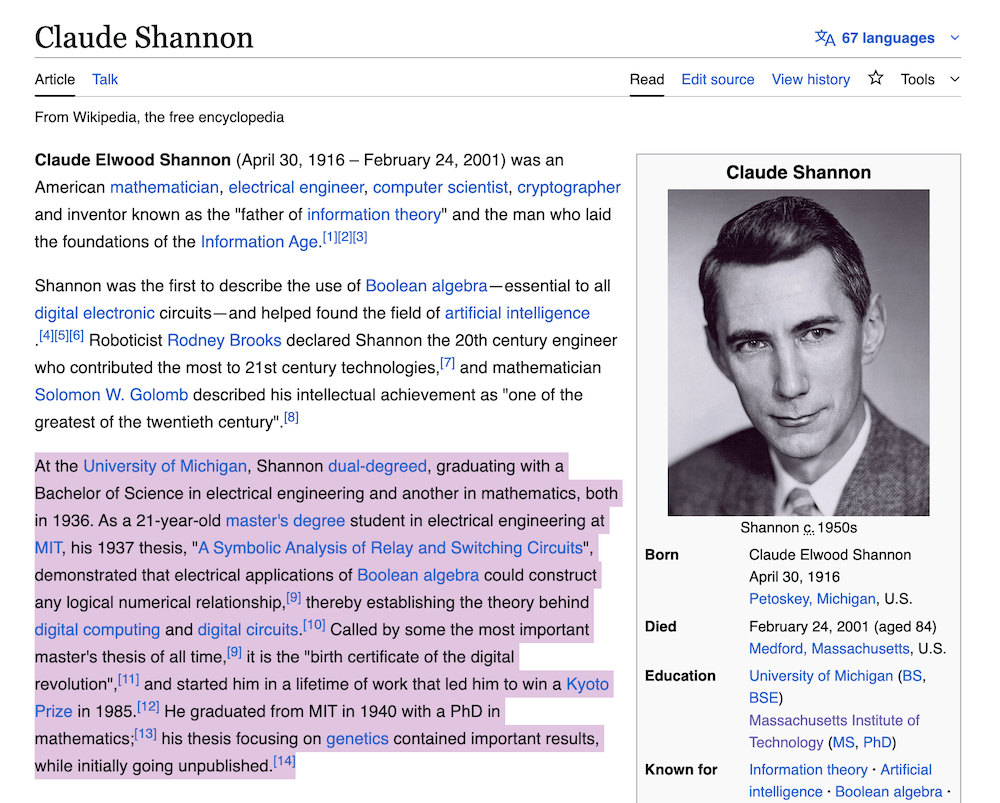
For example, if your university has a notable engineering program but isn’t listed in “List of engineering universities,” you could propose its addition on that list’s Talk page with sources demonstrating the program’s notability.
WikiProjects—groups of editors focused on specific topics—can help with these efforts. WikiProject Higher Education maintains many institution-related lists and templates. Engaging respectfully with these groups builds relationships that can support your long-term Wikipedia strategy. These editors understand higher ed institutions and can provide valuable guidance for improving your overall presence.
Wikipedia’s Quality Grades, and Why They Matter
Wikipedia uses a quality assessment system to rate articles from Stub (lowest) to Featured Article (highest). Understanding these grades helps you set realistic goals for your institution’s page.
Wikipedia’s Article Quality Grades |
|
| Grade | Description |
| Stub | Very short articles with minimal information—perhaps just a few sentences or a single paragraph. |
| Start | Short articles covering basic facts but missing substantial content in most areas. |
| C-Class | Substantial articles that cover the topic reasonably but have gaps, organizational issues, or sourcing problems. |
| B-Class | Comprehensive articles with good coverage of the subject, though still short of the highest standards. Most solid university articles fall here. |
| Good Article (GA) | Thoroughly researched articles meeting specific quality criteria, verified through a formal review process. |
| Featured Article (FA) | Wikipedia’s highest rating, reserved for comprehensive, well-written, thoroughly sourced articles that represent Wikipedia’s best work. |
These ratings matter because they signal quality to readers and influence how AI systems interpret and weight Wikipedia content. An article rated as Stub or Start suggests limited information and may cause AI tools to rely less heavily on it or flag it as incomplete.
Most institutions should realistically aim for B-Class—a comprehensive, well-sourced article that covers all major aspects of the institution. Achieving Good Article or Featured Article status requires extraordinary effort and typically involves experienced Wikipedia editors championing the article through rigorous review processes.
The rating appears on the article’s Talk page, not on the article itself, so most readers never see it. But editors use these assessments to prioritize improvement efforts and maintain quality standards across Wikipedia.
Wikipedia – Your Institution’s Digital Entity
Wikipedia has evolved from encyclopedia to essential infrastructure—shaping how search engines present your institution, what AI assistants say about you, and whether you register as a recognized entity in the database-driven world of modern search. Ignoring it creates real vulnerabilities as outdated information propagates through digital systems that prospective students, journalists, and donors increasingly rely on.
Success requires patience and respect for Wikipedia’s unique culture. Work transparently with volunteer editors, follow conflict-of-interest protocols, and commit to the platform’s standards for neutrality and verifiability. Start by auditing your current presence, identifying gaps, and building relationships with the Wikipedia community through proper channels.
The payoff can be substantial: accurate, comprehensive representation when it matters most—in AI responses, search results, and the research process of your next incoming class.
Managing Wikipedia effectively requires strategic expertise and careful execution. TELL ME MORE® helps higher education institutions build authentic digital presences that respect platform cultures while achieving institutional goals. Contact us to discuss how we can strengthen your institution’s Wikipedia presence the right way.